
Let's talk about dopamine
The neuroscience of high-dopamine activities, receptor sensitivity, and why your phone is quietly making everything else feel boring.

Jazz on low again. Chet Baker this time, the kind of trumpet that sounds like it’s grieving something beautiful. One spray of Gentleman Givenchy before sitting down, warm and clean, still there on the wrist two hours in. Some mornings the ritual is the whole point.
I want to talk to you about dopamine today.
Not in the vague, self-help way where someone tells you to do cold showers and eat blueberries.
In the actual way. The mechanistic way. The way that, once you understand it, makes you look at how you spend an average Tuesday completely differently.
Because here’s the thing nobody tells you about dopamine.
You have a finite capacity for it. Not infinite. Not unlimited. A system that can be sensitized, maintained, and protected, or progressively degraded depending entirely on what you’re feeding it every single day.
And most people are feeding it the neurological equivalent of junk food and then wondering why nothing feels rewarding anymore.
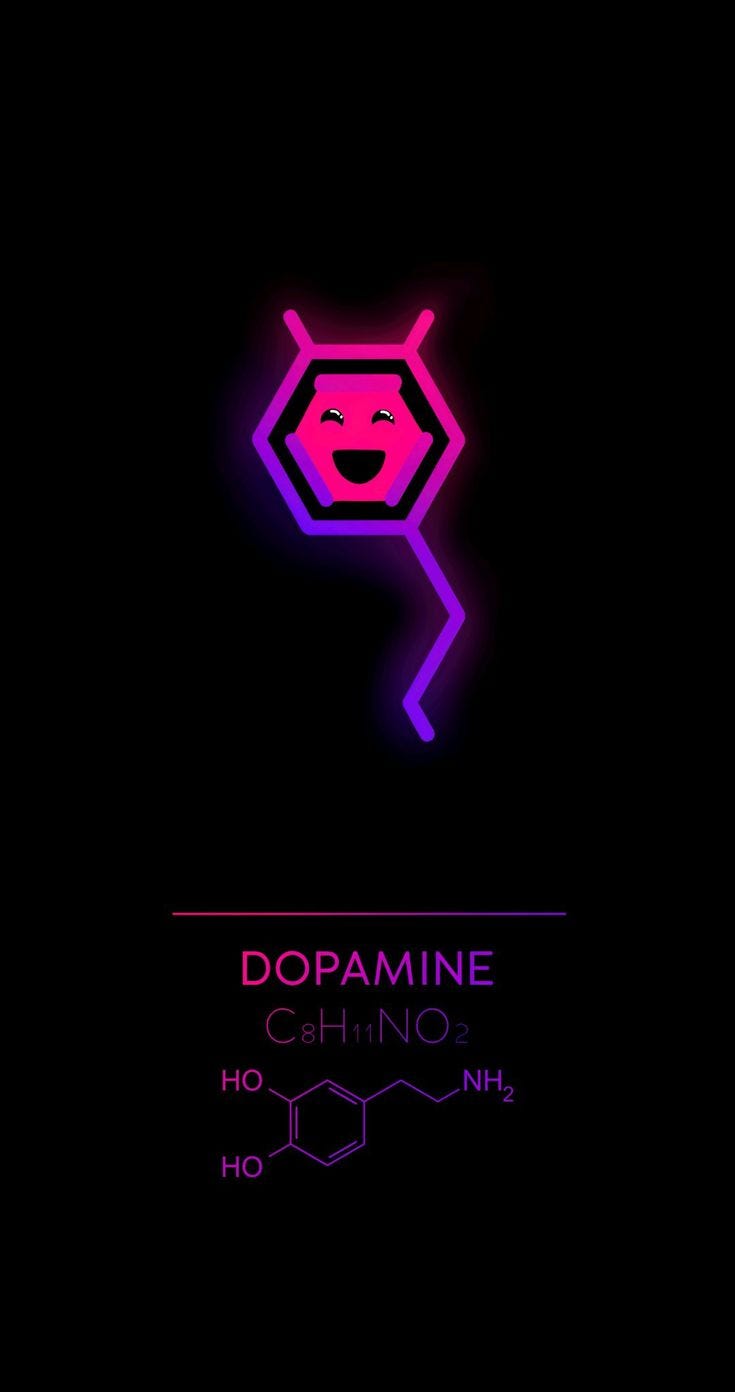
What Dopamine Actually Is
Let’s get this straight first because the popular understanding is almost entirely wrong.
Dopamine is not the pleasure chemical.
It is the wanting chemical.
It fires hardest not when you receive a reward but when your brain predicts one is coming. The anticipation. The craving. The drive to move toward something your nervous system has decided is worth pursuing.
This distinction matters more than most people realize.
It means the most intense dopamine experience of eating a meal you’ve been craving happens before the first bite. The scroll feels more compelling than the video you were scrolling to find. The plan feels more alive than the execution.
Your dopamine system is a prediction and pursuit engine. It is calibrated to the gap between where you are and where the reward is. And the size of that spike depends enormously on two things: the nature of the activity, and the current sensitivity of your receptors.
Receptor sensitivity is everything.
And it is the part that is completely under your control.
The Two Types of Dopamine Activities and Why the Difference Will Define Your Life
There are activities that release dopamine and build receptor sensitivity over time. And there are activities that release dopamine by borrowing against your system’s future capacity.
They feel similar in the moment. They are completely different in what they do to your brain over weeks and months.
The first category includes exercise, goal achievement, creating things, learning difficult skills, deep social connection, and music experienced with genuine attention. These activities produce dopamine release and, with consistent engagement, upregulate D2 receptor density in the striatum. More receptors means a stronger response from the same amount of dopamine. The reward system gets more sensitive, not less. Over time, the same workout keeps rewarding you, and eventually rewards you more than it did when you started.
The second category includes social media, pornography, ultra-processed food, gambling mechanics in video games, and any activity specifically engineered to produce variable reward schedules. These produce comparable or in some cases larger initial dopamine spikes, but with repeated exposure they trigger something called receptor downregulation. The postsynaptic cell, flooded with more dopamine than it was designed to handle regularly, responds by reducing the number of receptors available to receive the signal.
You need more stimulation to feel the same thing.
And here is the critical part that most people miss.
When your D2 receptor density drops, it doesn’t just affect your response to the thing that caused the drop. It affects your baseline capacity to feel reward from everything.
Exercise feels flat. Conversation feels dull. Progress on a project you care about registers as almost nothing.
This is not a mood issue. This is not laziness. This is your reward system operating at reduced sensitivity because of the inputs you’ve been giving it, and it is measurable on a brain scan.
The Effort-Reward Principle: Why Hard Things Feel Better
Here is one of the most important things neuroscience has established about dopamine that almost nobody outside of research circles talks about.
The size of a dopamine release is proportional to the effort that preceded the reward.
This is mechanistic.
Studies on effortful reward acquisition consistently show that rewards requiring significant effort to obtain produce larger dopamine responses in the nucleus accumbens than identical rewards delivered without effort. Your brain is not just tracking what you got. It is tracking what you did to get it.
This is why finishing a genuinely hard project produces a dopamine signal that finishing an easy one simply cannot match. Why a personal record in a lift you’ve been grinding for months hits differently than the first time you tried it. Why building something from nothing produces a sustained sense of reward that buying the equivalent thing never will.
The brain assigns dopamine proportional to the cost it paid.
Which means the shortcut path, the path that minimizes effort and maximizes immediate comfort, is also the path that trains your dopamine system to produce less and less of a reward response over time.
You are not just choosing between easy and hard.
You are choosing between a brain that finds the world rewarding and a brain that progressively doesn’t.
Exercise Is Not Optional. It’s Maintenance.
If you take nothing else from this post, take this.
Aerobic exercise is the single most powerful non-pharmacological intervention available for the dopamine system. Because of what consistent training does to receptor architecture over months.
Regular aerobic exercise upregulates dopamine receptors. It increases the availability of dopamine precursors in the brain. It improves the function of the prefrontal cortex, which is the system responsible for directing dopamine-driven motivation toward meaningful goals rather than letting it get hijacked by whatever is loudest in the environment.
A single 30-minute aerobic session produces measurable dopamine elevation in the striatum and prefrontal cortex. People dealing with low motivation, anhedonia, or the kind of grey flat feeling that makes everything seem like an effort will often notice a real shift within a single workout. Not because the workout fixed anything permanently but because it temporarily restored some of what was missing.
Done consistently, it doesn’t just restore. It builds.
The person who runs or trains regularly is not just physically healthier. Their reward system is structurally more sensitive. The same life events produce more pleasure, more motivation, more of the felt sense that things are worth doing.
The sedentary person is running their dopamine system on fumes and wondering why they can’t find the energy to build anything.
Music Does Something Almost Nothing Else Does
This one is worth understanding properly because it’s not obvious.
When a piece of music you love builds toward a resolution, the moment just before the peak, the breath before the chorus, the last bar before the drop, dopamine floods the caudate nucleus. Then at the moment of arrival, a second wave hits the nucleus accumbens.
Two distinct releases. Two anatomically separate brain regions. Sequenced one after the other by the structure of the music itself.
This is why music can produce chills, what researchers call frisson, and why that response doesn’t habituate the way most pleasures do. It is exploiting the anticipation circuit and the reward circuit in rapid succession, and the brain doesn’t seem to develop tolerance to it the way it does to most high-dopamine inputs.
Blocking dopamine pharmacologically eliminates the chills response entirely. Which confirms that what you feel when a song moves you is not metaphorical. It is a genuine dopaminergic event.
The person who puts on music as background noise is getting a fraction of this. The person who actually listens, who gives it attention, who lets it build, is getting the full sequence.
This is why what you’re doing with your attention while you consume something matters as much as what you’re consuming.
The Phone Is the Problem. Here’s the Mechanism.
Variable reward schedules produce some of the highest dopamine spikes of any activity. Higher than most natural rewards. The uncertainty of whether the next scroll will produce something interesting, the unpredictability of social feedback, the random distribution of novelty in an infinite feed, these are not accidental features.
They are engineered to exploit the exact mechanism that made dopamine useful in the first place: its sensitivity to unpredicted rewards.
Schultz’s foundational work showed that dopamine neurons fire most strongly in response to rewards that were not fully predicted. A guaranteed reward produces a muted signal. An uncertain one produces a spike proportional to the surprise.
Infinite scroll is a machine for manufacturing unpredicted micro-rewards at a rate your nervous system was never designed to handle.
And the consequence, with daily use over months and years, is the same as any other dopaminergic overstimulation. Receptor downregulation. Reduced baseline reward sensitivity. A brain that has calibrated itself to expect a level of stimulation that real life, real relationships, real work, cannot match.
This is why after an hour on your phone a walk outside feels boring. A conversation feels slow. A book feels impossible to start.
Your dopamine system has been recalibrated upward by artificial stimulation, and now everything natural is operating below the new threshold.
This is not a willpower problem.
It is a calibration problem.
And calibration can be fixed.
What Fixing It Actually Looks Like
The research on dopamine system recovery points to a few things consistently.
The first is abstinence or dramatic reduction of the high-stimulation inputs.
Receptor density begins recovering when the overstimulation stops. This is not instant. Studies on dopamine system recovery after chronic overstimulation suggest meaningful receptor upregulation takes weeks to months of reduced input. There is no shortcut here.
The second is replacing the high-stimulation inputs with effort-based natural dopamine activities.
Exercise, skill acquisition, creative work, genuine social connection. Not as punishment. As recalibration. You are building a new baseline, a new normal, a new reference point for what rewarding feels like.
The third is protecting novelty.
The dopamine system responds strongly to new experiences and environments. Introducing genuine novelty, new physical spaces, new skills, new social situations, helps sustain the signal during recovery because novelty is one of the inputs that doesn’t produce tolerance in the same way repetitive stimulation does.
And the fourth is time.
There is no faster path.
The people who have done this describe the experience on the other side in almost identical terms: things that used to feel dull start to feel interesting again. A good conversation becomes genuinely absorbing. A run produces a high that was missing for years. A project starts to feel worth working on.
That is receptor density recovery.
(Study that)
That is your brain returning to the sensitivity it was designed to operate at before the modern environment spent years slowly turning it down.
You already know what’s eating your dopamine.
You’ve known for a while.
The question is whether you’re going to keep pretending the cost isn’t real.
You just read something most people will never come across.
You’re here reading the actual mechanism.
That gap between you and “them” just got wider.
The “Upgrade” button down below is the final step.
The paid tier is where it goes deeper.
The neuroscience of dopamine and why your reward system is being systematically recalibrated without your knowledge. The nervous system under chronic stress and what it’s doing to your prefrontal cortex in real time. Sleep architecture, working memory, neuroplasticity, emotional regulation, the whole map of how you actually work and why you do what you do.
Not summaries. Not listicles. The real mechanisms, the ones that change how you see yourself and everyone around you permanently.
$10 a month.
Less than a single mediocre lunch.
For a library of material that will make you think differently about your brain, your behavior, and what’s actually possible for you, for the rest of your life.
The people who upgrade don’t do it because they have extra money sitting around. They do it because they recognize the moment when something is genuinely worth it, and they move on that feeling instead of talking themselves out of it.
You already know if this is for you.
The button “Upgrade” is right below. Click it.
Check out some premium posts:
Would love an article from you on prioritising process over outcome.