
Conditional Manipulation: Control Yourself
How every repeated thought, habit, and quiet compromise is chemically sculpting the person you’re becoming, whether you’re aware of it or not.

Jazz on low. Coltrane this morning, “A Love Supreme,” third track, the one that feels like something being resolved that you didn’t know was unresolved. One spray of Gentleman Givenchy on the wrist before I sat down. Small rituals. They matter more than people think, and I’ll explain exactly why by the end of this post.
Coffee’s hot. Let’s go.
I want to talk about something that almost nobody frames correctly.
I want to talk about what you are doing to yourself.
Quietly. Repeatedly.
Because there is a version of self-conditioning that most people never examine, and it is one of the most consequential things happening inside your skull right now.
Every thought you repeat becomes a pathway. Every behavior you run becomes a groove. Every compromise you make in private, every small act of courage or cowardice, every story you tell yourself about who you are and what you’re capable of, all of it is being written into the physical architecture of your brain in real time.
You are are training something.
The question is whether you know what you’re training it toward.
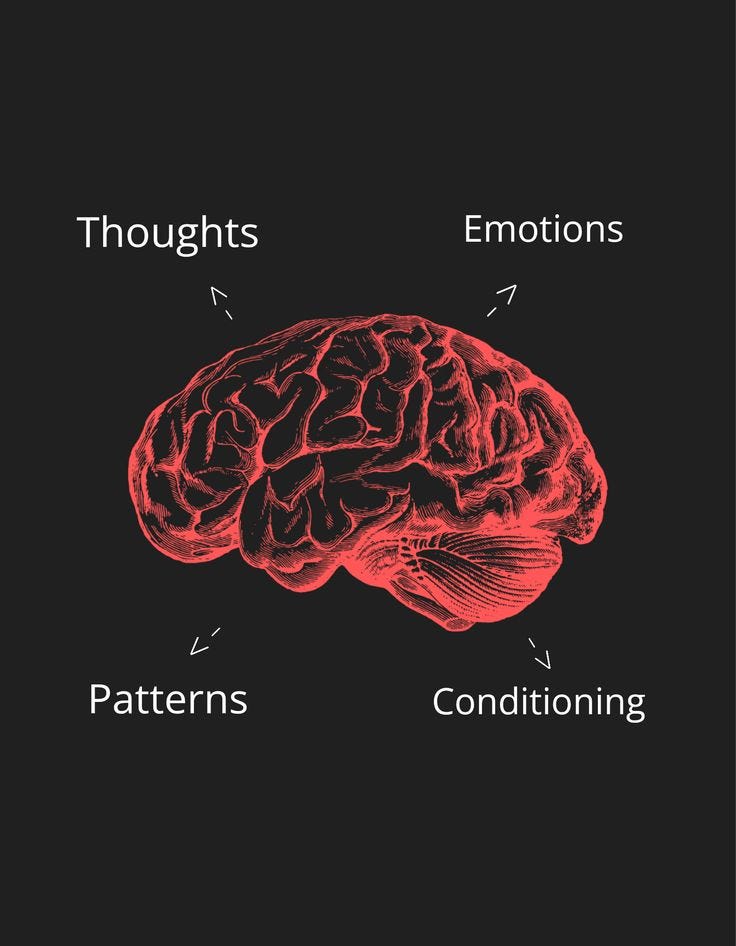
What Self-Conditioning Actually Is
The clinical term is autoconditioning, and it sits at the intersection of behavioral psychology and neuroscience in a way that most self-help content completely ignores because it’s easier to sell people frameworks than to explain the underlying mechanism.
Here’s the mechanism.
Every time a thought fires in your brain, a specific pattern of neurons activates. The more that same pattern fires, the more efficiently those neurons communicate. The axons get wrapped in myelin, the insulating sheath that speeds up electrical transmission, making the signal faster and more automatic each time it runs.
Hebb’s Law, formulated by neuropsychologist Donald Hebb in 1949, describes this as: neurons that fire together wire together.
It is one of the most important sentences in all of neuroscience.
Because what it means is that repetition is not neutral.
Every time you think a thought, you are voting for that thought to become more automatic. Every time you perform an action, you are making that action more hardwired. Every time you react to a situation in a particular way, you are increasing the probability that you will react the same way next time.
Your brain is actively reshaping itself around whatever you repeat.
This is neuroplasticity working for you or against you, depending entirely on what you’re feeding it.
The Conditioning Nobody Talks About
Here’s where it gets uncomfortable.
Most people understand this concept in the context of habits. Exercise, diet, reading, waking up early. Repeat the good behavior, build the good pathway. Makes sense. Fine.
But the conditioning that actually runs most people’s lives is the thought conditioning.
Read that again.
And specifically, it’s the private thought conditioning that happens in the space between what you do and what you tell people you do.
Every morning you wake up and the first thought that appears is a signal. Not just about your mood, about the pathway your brain has been reinforcing during every previous morning. If the first thing that surfaces is dread, that dread is not random. It’s a well-myelinated highway that your brain built one anxious morning at a time until it became the automatic output.
Every time you talk yourself out of doing something hard and then tell yourself a story about why that was actually the reasonable choice, you strengthen two pathways simultaneously.
The avoidance pathway.
And the rationalization pathway.
The second one is more dangerous than the first.
Because the avoidance at least registers somewhere as discomfort. The rationalization smooths it over and leaves no trace. Your brain files it as a sound decision rather than a retreat, which means next time the same situation arises, the retreat fires faster and the rationalization fires right behind it, and the whole thing feels less like a choice and more like just what makes sense.
You have conditioned yourself to believe that the path of least resistance is actually discernment.
That’s a neural pattern that got built one repetition at a time and now runs automatically.
Positive Conditioning Works the Same Way, and That’s the Point
This is a post about how the mechanism is neutral.
The exact same process that builds the avoidance highway builds the execution highway.
The same myelination that hardens your self-doubt also hardens your self-belief, if that’s the pattern you run instead.
Think about what actually happens in your brain when you do something difficult that you didn’t want to do.
You sat down to work when every signal in your body was pulling toward distraction. You said the honest thing when the comfortable lie was right there. You followed through on something you told yourself you’d follow through on.
In the moment, those feel like small things.
They are not small things.
Each one of those is a deliberate firing of a specific neural pattern. Each firing makes the next firing slightly easier. Over hundreds of repetitions that pathway becomes the default. The identity follows the behavior because the brain that repeatedly executes hard things begins to process execution as normal rather than exceptional.
This is what people mean when they talk about confidence being built through action rather than thought.
It’s literal description of how myelin accumulates around the patterns you rehearse most.
The person who seems unshakably disciplined is not blessed with some constitutional advantage over you.
They have a very well-myelinated execution pathway and a comparatively thin avoidance pathway.
That’s it.
That’s the whole difference.
And both of those things are trainable.
The Thought Schemes That Condition You Downward Without You Noticing
There are specific patterns of thinking that most people run on repeat without recognizing them as conditioning events.
The first is catastrophic projection. The habit of taking a current difficulty and running a mental simulation forward in which it compounds into the worst possible outcome. Most people do this constantly and treat it as realism. It is not realism. It is a practiced neural pattern that, the more you run it, the more automatically your brain generates catastrophic narratives in response to stress. You are rehearsing suffering that hasn’t happened yet and building the pathway that makes the rehearsal faster next time.
The second is identity foreclosure. This is the thought pattern of “I’m just not someone who” followed by whatever behavior you’ve decided is unavailable to you. I’m just not someone who is good at mornings. I’m just not someone who can stay consistent. I’m just not someone who finishes things. Every time you run this sentence your brain strengthens the neural representation of that identity. You are not describing yourself. You are conditioning yourself. The statement feels like observation but it functions as instruction.
The third is what I’d call the private compromise. This one is subtle and it does the most damage. It’s the moment when you make a commitment to yourself, no one else is watching, no external accountability exists, and then you quietly don’t follow through. And then you do it again. And again. Each instance is a training event. Not for failure specifically, but for the relationship between your word and your action. You are teaching your brain that your internal commitments are negotiable. That the self who makes the plan and the self who executes it are not the same person and don’t need to be.
This conditioning is why so many people find external accountability works where internal commitment doesn’t.
It’s because they’ve spent years training the gap between intention and execution until it became structural.
Why the Small Rituals Are Not Small
Back to the jazz. Back to the Givenchy.
I said I’d explain why rituals matter more than people think, and here’s the neuroscience of it.
A ritual is a repeated behavioral sequence that your brain learns to use as a state-change trigger.
When you perform the same sequence of actions before a particular type of activity, you are building a conditioned association between that sequence and the neural state that follows. Over enough repetitions, the sequence begins to summon the state rather than simply precede it.
This is why pre-performance routines work for athletes. It’s why writers have rituals. It’s why the same ambient environment day after day starts to feel like a signal to the brain that a particular kind of thinking is about to happen.
You are installing a conditional trigger.
And the trigger, once installed, bypasses a lot of the resistance that comes from having to build focus from scratch every time.
The brain that hears a specific piece of music and smells a specific scent before sitting down to work is receiving environmental cues that have been associated with that work state through repetition.
It’s associative conditioning working in your favor for once.
You can design this deliberately.
Same time, same environment, same sensory anchors, same sequence before the work begins. Not because those things are magical in themselves but because your brain will learn to use them as shortcuts to the state you want.
Consistency of context is consistency of neural activation.
What You Do With This
Audit the thoughts you repeat most.
Not the ones you’re aware of performing. The automatic ones. The ones that fire before you’ve decided to think anything. The first thought when you wake up. The thought that appears when you’re about to do something difficult. The story that surfaces when something goes wrong.
Those are your most well-myelinated pathways.
They tell you more about who you’re becoming than any conscious intention you have.
And they are not fixed.
But they will not change through insight alone.
They change through repetition of something different.
You have to run the new pathway enough times that it begins to compete with the old one. You have to make the new thought in the specific moment when the old one would have fired. Not afterward in reflection. In the moment, under the same conditions, with the same triggers present.
That’s the work.
It’s not complicated.
It’s just relentless.
Every repeated thought is a vote.
Every followed-through commitment is a vote.
Every moment you catch the rationalization mid-sentence and choose the harder thing instead is a vote.
You are casting them constantly whether you’re paying attention or not.
The question is just whether the votes are going somewhere you actually want to end up.
The people who read this post and feel something click are exactly the kind of people who already know the free tier isn't enough for them.
The paid posts go where this one only points.
Full breakdowns of the default mode network, dopamine recalibration protocols, the nervous system deep dive, the subconscious conditioning frameworks that make everything covered here actionable at a level most people never reach.
$10 a month.
Once you will join us nothing will be the same.
Less than one coffee a week.
If you're the type of person who actually does something with information rather than just collecting it, you already know what to do.
The button is below.
You are what you tell yourself you are. I first became aware of this concept in sales. A profession I had a really tough time with early on in my career. I had a ton of self doubt. I recently read some books by Jed Blount. He shares the concept of repeating positive thoughts over and over again prior to making sales calls. It’s made a huge difference in my ability to have effective sales conversations with strangers.
It's amazing how our brains were created with the ability to be "rewired". We simply have to consistently make a conscious effort to do so